Gout Pharmacotherapy – Test Prep and Practice Pearls

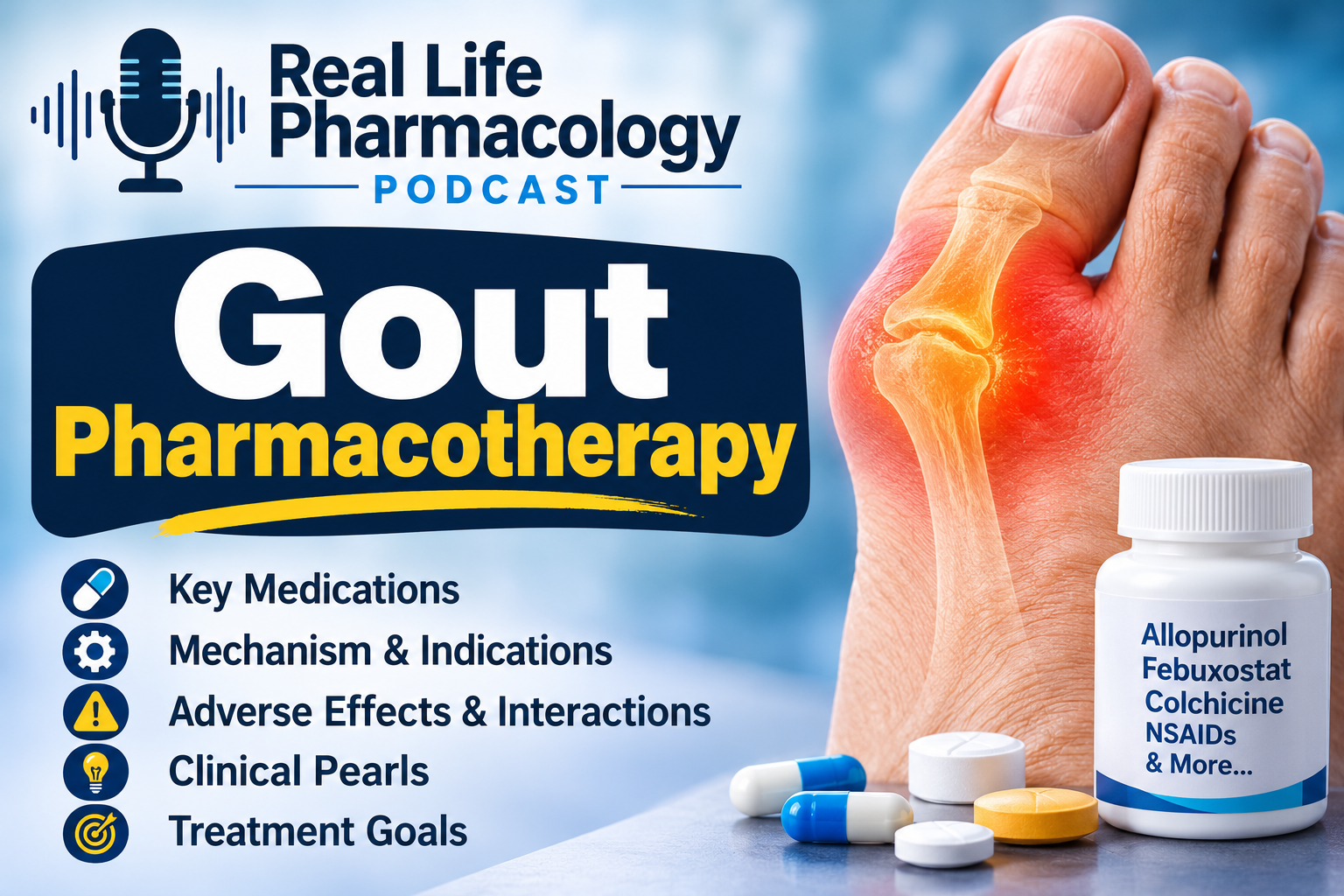
Gout pharmacotherapy involves more than just treating painful flare-ups. In this episode of Real Life Pharmacology, we review the most commonly used gout medications, including allopurinol, febuxostat, colchicine, probenecid, NSAIDs, and corticosteroids. Learn how these medications work, their indications, important adverse effects, clinically significant drug interactions, and practical prescribing pearls. We also discuss uric acid treatment goals, prevention of recurrent gout attacks, renal dosing considerations, and important medication safety concerns. Whether you are a pharmacist, nurse, physician, or healthcare professional preparing for a board certification exam, this episode will help strengthen your understanding of gout treatment and evidence-based gout pharmacotherapy.

Be sure to check out our free Top 200 study guide – a 31 page PDF that is yours for FREE!

Support The Podcast and Check Out These Amazing Resources!

NAPLEX Study Materials

BCPS Study Materials

BCACP Study Materials

BCGP Study Materials

BCMTMS Study Materials

Nursing Pharmacology Review Course

Meded101 Guide to Nursing Pharmacology (Amazon Highly Rated)

Guide to Drug Food Interactions (Amazon Best Seller)

Pharmacy Technician Study Guide by Meded101

Pharmacy Technician Bootcamp (PTCB Exam Prep Course) – 4.8/5 star course rating

Addison’s and Cushing’s Disease Section 4.1 – Nursing Pharmacology Review Course

This podcast episode provides nurses with a practical, clinically focused overview of Addison’s disease and Cushing’s disease, highlighting key differences in pathophysiology, presentation, and management. Listeners will learn how adrenal insufficiency in Addison’s leads to symptoms like fatigue, hypotension, and hyperpigmentation, while excess cortisol in Cushing’s presents with weight gain, hypertension, and glucose intolerance. The episode emphasizes important nursing considerations such as recognizing adrenal crisis, monitoring electrolytes and blood pressure, patient education on steroid adherence, and identifying medication-related causes of Cushing’s.

Be sure to check out our free Top 200 study guide – a 31 page PDF that is yours for FREE!

Top 200 Drugs Podcast – Medications 56-60

This episode is sponsored by Freed – Freed is an amazing time saver for busy healthcare professionals! It listens, transcribes, and writes medical notes for you! Go check them out and support our sponsor!

In this episode, we highlight some of the most important clinical pearls on the following medications; nitrofurantoin, fentanyl patches, isosorbide mononitrate, fluoxetine, and triamcinolone.

Nitrofurantoin is an antibiotic used for UTIs. We need to be careful with this medication in patients with CKD.

Fentanyl is an opioid. There are many clinical quirks with fentanyl patches. For a full rundown, check out this previous podcast episode.

Isosorbide mononitrate is a nitrate medication so we need to be careful with the use of PDE-5 inhibitors.

Fluoxetine is an SSRI. It has a longer half-life than most SSRIs. I discuss what that means in this episode.

Triamcinolone (topical) is most frequently used for redness, itching, and skin irritation.

Be sure to check out our free Top 200 study guide – a 31 page PDF that is yours for FREE!

Dexamethasone Pharmacology

Dexamethasone has numerous possible indications such as asthma, chemotherapy-induced nausea and vomiting, and pain associated with inflammation.

Dexamethasone is more potent than prednisone. Approximately 0.75 mg of dexamethasone is equivalent to 5 mg of prednisone.

When using dexamethasone, recall that it can raise blood sugars. Monitor this closely in patients with diabetes.

A dexamethasone suppression test helps detect excessive endogenous production of cortisol.

I discuss important drug interactions on the podcast, be sure to check out my latest project which is a 200+ page book on managing drug interactions in primary care.

Be sure to check out our free Top 200 study guide – a 31 page PDF that is yours for FREE!

Budesonide Formoterol Pharmacology

Budesonide and Formoterol Pharmacology

Budesonide/formoterol inhalation is sold under the brand name Symbicort.

Budesonide/formoterol is a combination agent that is used in the management of COPD and asthma.

Budesonide/formoterol is a combination of an inhaled corticosteroid and long-acting beta-agonist.

GINA guidelines now allow for the use of budesonide/formoterol in the management of acute asthma exacerbation.

Be sure to check out our free Top 200 study guide – a 31 page PDF that is yours for FREE!